<?xml version="1.0" encoding="utf-8"?><feed xmlns="http://www.w3.org/2005/Atom" xml:lang="en"><generator uri="https://jekyllrb.com/" version="4.2.2">Jekyll</generator><link href="https://michaelsqj.github.io/feed.xml" rel="self" type="application/atom+xml" /><link href="https://michaelsqj.github.io/" rel="alternate" type="text/html" hreflang="en" /><updated>2026-07-25T02:11:09+08:00</updated><id>https://michaelsqj.github.io/feed.xml</id><title type="html">Qijia Shen</title><subtitle>Research in agentic AI, reinforcement learning, training infrastructure, and computational imaging.</subtitle><author><name>Qijia Shen</name></author><entry><title type="html">4D Combined Angiography and Perfusion using Radial Imaging and Arterial Spin Labeling</title><link href="https://michaelsqj.github.io/blog/2021/4D-Combined-Angiography-and-Perfusion-using-Radial-8371ec4ffdde4d8d9b67e7b0a662c7bd/" rel="alternate" type="text/html" title="4D Combined Angiography and Perfusion using Radial Imaging and Arterial Spin Labeling" /><published>2021-09-25T00:00:00+08:00</published><updated>2021-09-25T00:00:00+08:00</updated><id>https://michaelsqj.github.io/blog/2021/4D%20Combined%20Angiography%20and%20Perfusion%20using%20Radial%208371ec4ffdde4d8d9b67e7b0a662c7bd</id><content type="html" xml:base="https://michaelsqj.github.io/blog/2021/4D-Combined-Angiography-and-Perfusion-using-Radial-8371ec4ffdde4d8d9b67e7b0a662c7bd/"><![CDATA[<p><strong>Sequence</strong>: 4D implementation of Combined Angiography and Perfusion using <strong>Radial Imaging and Arterial Spin Labeling</strong> (<strong>CAPRIA</strong>)</p>

<p><strong>Reconstruction</strong>: whole-brain <strong>dynamic</strong> <strong>angiogram</strong>, time-resolved <strong>perfusion</strong> map from <strong>same raw data set</strong></p>

<p>angiography: blood flow in large arteries to visualize stenoses, occlusions, abnormal vessels.</p>

<p>perfusion:</p>]]></content><author><name>Qijia Shen</name></author><category term="ASL" /><category term="MRI" /><category term="Paper" /><summary type="html"><![CDATA[Sequence: 4D implementation of Combined Angiography and Perfusion using Radial Imaging and Arterial Spin Labeling (CAPRIA)]]></summary></entry><entry><title type="html">A joint compressed-sensing and super-resolution approach for very high-resolution diffusion imaging</title><link href="https://michaelsqj.github.io/blog/2021/A-joint-compressed-sensing-and-super-resolution-ap-0cdd70f5425a466e8a3c8ff743aa8a9e/" rel="alternate" type="text/html" title="A joint compressed-sensing and super-resolution approach for very high-resolution diffusion imaging" /><published>2021-09-25T00:00:00+08:00</published><updated>2021-09-25T00:00:00+08:00</updated><id>https://michaelsqj.github.io/blog/2021/A%20joint%20compressed-sensing%20and%20super-resolution%20ap%200cdd70f5425a466e8a3c8ff743aa8a9e</id><content type="html" xml:base="https://michaelsqj.github.io/blog/2021/A-joint-compressed-sensing-and-super-resolution-ap-0cdd70f5425a466e8a3c8ff743aa8a9e/"><![CDATA[]]></content><author><name>Qijia Shen</name></author><category term="Compress_Sensing" /><category term="Paper" /><category term="dMRI" /><summary type="html"><![CDATA[]]></summary></entry><entry><title type="html">Advances in arterial spin labelling MRI methods for measuring perfusion and collateral flow</title><link href="https://michaelsqj.github.io/blog/2021/Advances-in-arterial-spin-labelling-MRI-methods-fo-e2553840a6324f70a29d37ca80e8fa0e/" rel="alternate" type="text/html" title="Advances in arterial spin labelling MRI methods for measuring perfusion and collateral flow" /><published>2021-09-25T00:00:00+08:00</published><updated>2021-09-25T00:00:00+08:00</updated><id>https://michaelsqj.github.io/blog/2021/Advances%20in%20arterial%20spin%20labelling%20MRI%20methods%20fo%20e2553840a6324f70a29d37ca80e8fa0e</id><content type="html" xml:base="https://michaelsqj.github.io/blog/2021/Advances-in-arterial-spin-labelling-MRI-methods-fo-e2553840a6324f70a29d37ca80e8fa0e/"><![CDATA[]]></content><author><name>Qijia Shen</name></author><category term="ASL" /><category term="MRI" /><category term="Paper" /><category term="Review" /><summary type="html"><![CDATA[]]></summary></entry><entry><title type="html">An Introduction to Compressive Sensing</title><link href="https://michaelsqj.github.io/blog/2021/An-Introduction-to-Compressive-Sensing-aae2eabc2f8a44219a08688ba6190adc/" rel="alternate" type="text/html" title="An Introduction to Compressive Sensing" /><published>2021-09-25T00:00:00+08:00</published><updated>2021-09-25T00:00:00+08:00</updated><id>https://michaelsqj.github.io/blog/2021/An%20Introduction%20to%20Compressive%20Sensing%20aae2eabc2f8a44219a08688ba6190adc</id><content type="html" xml:base="https://michaelsqj.github.io/blog/2021/An-Introduction-to-Compressive-Sensing-aae2eabc2f8a44219a08688ba6190adc/"><![CDATA[]]></content><author><name>Qijia Shen</name></author><category term="Book" /><category term="Compress_Sensing" /><summary type="html"><![CDATA[]]></summary></entry><entry><title type="html">An integrated approach to correction for off-resonance effects and subject movement in diffusion MR imaging</title><link href="https://michaelsqj.github.io/blog/2021/An-integrated-approach-to-correction-for-off-reson-179c527bb02e4b0ba3ef428a3778f75d/" rel="alternate" type="text/html" title="An integrated approach to correction for off-resonance effects and subject movement in diffusion MR imaging" /><published>2021-09-25T00:00:00+08:00</published><updated>2021-09-25T00:00:00+08:00</updated><id>https://michaelsqj.github.io/blog/2021/An%20integrated%20approach%20to%20correction%20for%20off-reson%20179c527bb02e4b0ba3ef428a3778f75d</id><content type="html" xml:base="https://michaelsqj.github.io/blog/2021/An-integrated-approach-to-correction-for-off-reson-179c527bb02e4b0ba3ef428a3778f75d/"><![CDATA[<p><strong>目的</strong>：estimation and correction for eddy current induced distortion, subject movement. susceptibility field can also be included.</p>

<ul>
  <li>register each volume to a model free prediction of what each volume should look like
    <ul>
      <li>common assumption in registration: images are identical except for geometric transform</li>
      <li>in dMRI, images with different gradient weighting have different contrast</li>
    </ul>
  </li>
  <li>linear (combination of gradients) EC-model is insufficient for high resolution data → higher order model better</li>
</ul>

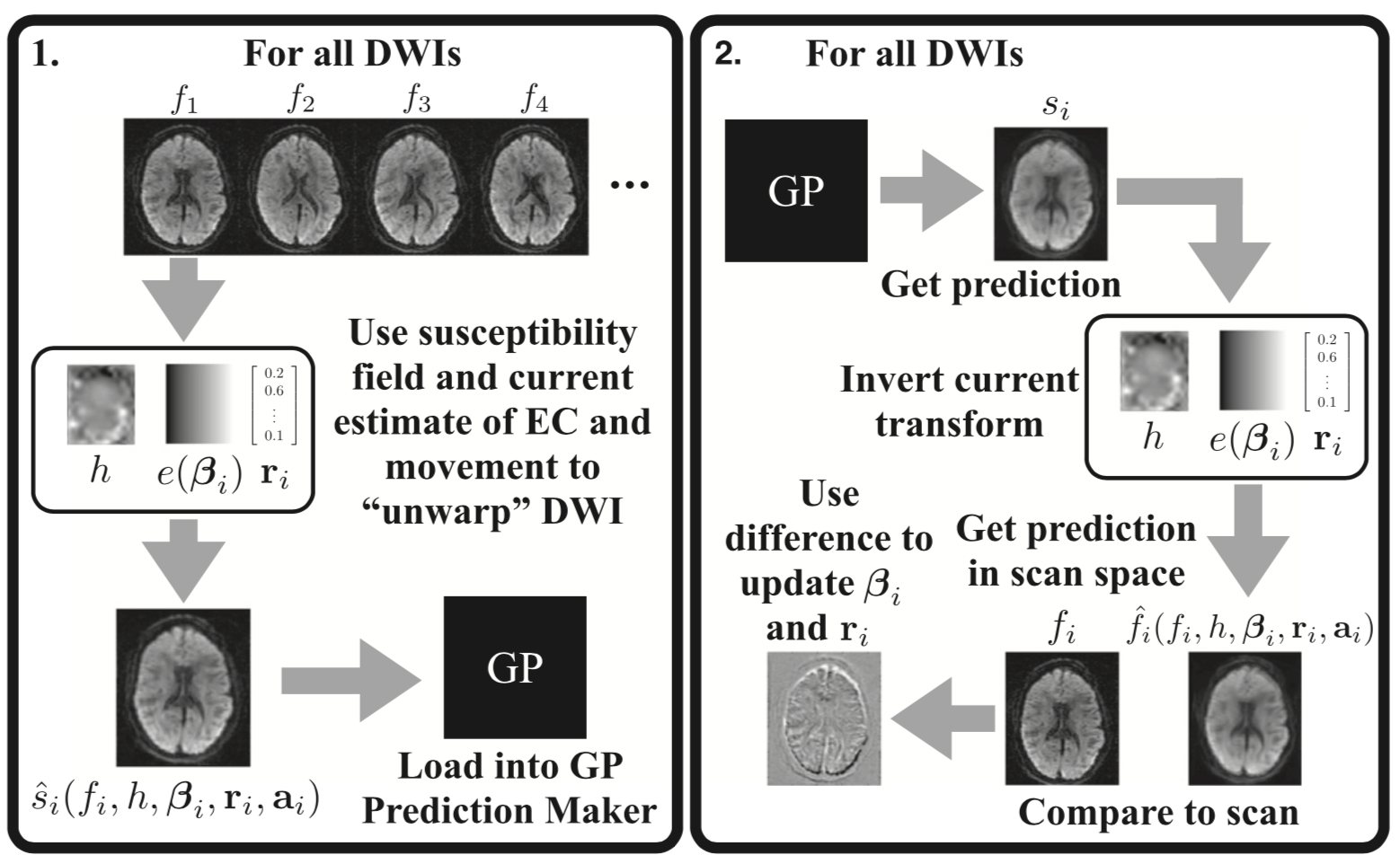
<div class="row mt-3"><div class="col-sm mt-3 mt-md-0"><img class="img-fluid rounded z-depth-1" src="/assets/img/An%20integrated%20approach%20to%20correction%20for%20off-reson%20179c527bb02e4b0ba3ef428a3778f75d/Untitled.png" data-zoomable="" /></div></div>

<h3 id="including-susceptibility-induced-field">Including susceptibility-induced field</h3>

<p>通过dual echo-time fieldmap sequence或者reverse gradient method</p>

<p>一般用<strong>TOPUP</strong>产生的susceptibility map</p>

<p>EC-induced distortion: <strong>in plane</strong> shears/ zooms/ translations along PE direction。Low order polynomial of gradient field.</p>

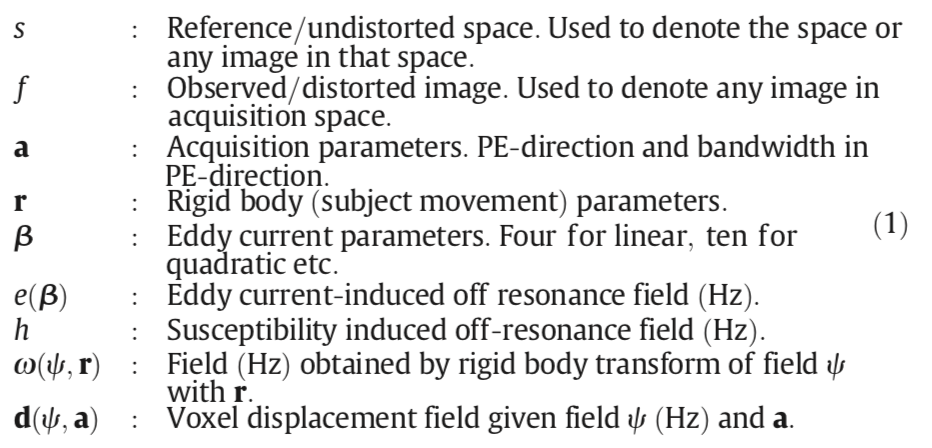
<div class="row mt-3"><div class="col-sm mt-3 mt-md-0"><img class="img-fluid rounded z-depth-1" src="/assets/img/An%20integrated%20approach%20to%20correction%20for%20off-reson%20179c527bb02e4b0ba3ef428a3778f75d/Untitled%201.png" data-zoomable="" /></div></div>

<h3 id="combining-the-fields">Combining the fields</h3>

<p>EC-induced field : 在MRI坐标系下静止</p>

<p>susceptibility induced field：相对人体坐标系静止</p>

<p>$\mathbf{x’=R_i^{-1}x+d_x}[h+w(e(\beta_i),\mathbf{r_i}),\mathbf{a_i}]$</p>

<p>$\mathbf{x}$表示reference space $s$ (susceptibility field $h$ is estimated in reference space)中的坐标，$\mathbf{x’}$是observed space $f$ 中的坐标。</p>

<p>坐标逆变换</p>

<p>$\mathbf{x’=R_i(x+d_x}[h+w(e(\beta_i),\mathbf{r_i}),\mathbf{a_i}]^{-1})$</p>

<p>$d_x[h+w(e(\beta_i),\mathbf{r_i}),\mathbf{a_i}]^{-1}$是$d[h+w(e(\beta_i),\mathbf{r_i}),\mathbf{a_i}]$<strong>整个空间的displacement field矩阵求逆</strong>后坐标 $\mathbf{x}$ 处的值。<strong>如果图像不是方的，也就是矩阵宽高不等怎么求逆？</strong></p>

<h3 id="resampling-the-images">Resampling the images</h3>

<p>因为变换后的坐标$\mathbf{x’}$不一定是整数，所以需要插值重采样。同时仿照我们在多重积分坐标变换中做的，再乘上雅各比矩阵，否则变换后的坐标疏密不均。</p>

<p>$\hat{s_i}(\mathbf{x};f_i,h,\mathbf{\beta_i,r_i,a_i})=f_i(\mathbf{x’})J_x(h,\mathbf{\beta_i,r_i,a_i})$</p>

<p>逆变换</p>

<p>$\hat{f_i}(\mathbf{x};s_i,h,\mathbf{\beta_i,r_i,a_i})=s_i(\mathbf{x’})J_x^{-1}(h,\mathbf{\beta_i,r_i,a_i})$</p>

<h3 id="predicting-diffusion-data">Predicting diffusion data</h3>

<p>因为不同的gradient获得的dMRI图像对比度都是不同的，因此不能简单的将所有gradient下的图像register到某一个图像上。</p>

<p>本文中是用GP，根据其他所有gradient下的图像，预测一个gradient下的图像应该长什么样，然后将当前gradient下的图像配准到预测的图像上。</p>

<p><strong>不懂为什么配准就可以去除eddy，susceptibility的影响？前面的combine the fields有什么用？</strong></p>

<h3 id="the-registration-algorithm">The registration algorithm</h3>

<p>初始化$\beta_i,r_i$为0</p>

<p>for M iterations:</p>

<p>计算$\hat{s_i}(\mathbf{x};f_i,h,\mathbf{\beta_i,r_i,a_i})$，$i\in [1,N]$</p>

<p>训练GP model</p>

<p>从GP model 预测$s_i$</p>

<p>逆变换回$\hat{f_i}(\mathbf{x};s_i,h,\mathbf{\beta_i,r_i,a_i})$</p>

<p>用$f_i-\hat{f_i}$更新$\beta_i,r_i$</p>

\[D\left(\begin{bmatrix}\beta_i^{k+1}\\r_i^{k+1}\end{bmatrix}-\begin{bmatrix}\beta_i^{k}\\r_i^{k}\end{bmatrix}\right)=\hat{f_i}-f_i\]

\[D=\left[\frac{\partial \hat{f_i}}{\partial \beta_{1i}}\cdots\frac{\partial \hat{f_i}}{\partial \beta_{ni}};\quad \frac{\partial \hat{f_i}}{\partial r_{1i}}\cdots\frac{\partial \hat{f_i}}{\partial r_{mi}}\right]\]

<p>梯度下降方法 $D=\nabla f_i$</p>

<h3 id="data-requirements-for-eddy">Data requirements for eddy</h3>

<ul>
  <li>相反的梯度方向。$-\mathbf{g,g}$，diffusion 的信息相同，distortion的信息差距大</li>
  <li>不同的采集方式，比如相反的PE-direction。</li>
</ul>

<h3 id="second-level-modeling">Second level modeling</h3>

<blockquote>
  <p><strong>eddy has no inherent knowledge of the “undistort- ed space” and just registers all volumes towards an average space. If the diffusion gradients are evenly distributed on the whole sphere, that space will be close to “undistorted space”</strong></p>
</blockquote>

<p>model the EC-estimates as a function of the diffusion gradients with zero intercept，为什么这个second level model 可行？</p>

<h3 id="final-resampling">Final resampling</h3>]]></content><author><name>Qijia Shen</name></author><category term="MRI" /><category term="Machine_Learning" /><category term="Paper" /><summary type="html"><![CDATA[Eddy Correction; Gaussian Process]]></summary></entry><entry><title type="html">Arterial spin labeling for the measurement of cerebral perfusion and angiography</title><link href="https://michaelsqj.github.io/blog/2021/Arterial-spin-labeling-for-the-measurement-of-cere-154e90dbf9c8463e9136e93a1758a914/" rel="alternate" type="text/html" title="Arterial spin labeling for the measurement of cerebral perfusion and angiography" /><published>2021-09-25T00:00:00+08:00</published><updated>2021-09-25T00:00:00+08:00</updated><id>https://michaelsqj.github.io/blog/2021/Arterial%20spin%20labeling%20for%20the%20measurement%20of%20cere%20154e90dbf9c8463e9136e93a1758a914</id><content type="html" xml:base="https://michaelsqj.github.io/blog/2021/Arterial-spin-labeling-for-the-measurement-of-cere-154e90dbf9c8463e9136e93a1758a914/"><![CDATA[<p><strong>ASL 作用</strong>：quantitative measurement of <strong>cerebral perfusion</strong> and <strong>cerebral angiography</strong>
<strong>ASL 主要类型</strong>：PASL (pulsed ASL), CASL (continuous ASL), vsASL (velocity-selective ASL), pCASL (pseudo-continuous ASL)</p>

<p>flow-driven <strong><a href="http://mriquestions.com/adiabatic-excitation.html">adiabatic inversion</a></strong></p>

<p><a href="https://radiologykey.com/basic-principles-of-arterial-spin-labeling-continuous-versus-pulsed-arterial-spin-labeling/">Basic Principles of Arterial Spin Labeling: Continuous versus Pulsed Arterial Spin Labeling</a></p>

<p><a href="http://mriquestions.com/off-resonance.html"><strong>off-resonance RF pulse</strong></a></p>

<h2 id="问题"><strong>问题：</strong></h2>

<ol>
  <li>bSSFP readout</li>
  <li>AIF, residue function</li>
  <li>为什么要measure perfusion，perfusion是只测量一个很小的区域吗，blood到了这个区域就停止了吗？</li>
  <li>怎样通过navigator 去correct motion</li>
</ol>

<h2 id="physical-principles-of-asl">Physical Principles of ASL</h2>

<h3 id="pcasl">pCASL</h3>

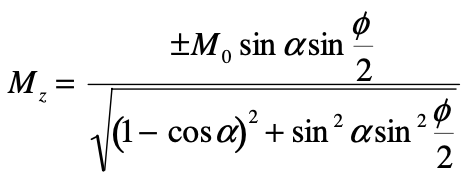
<p>a single long pulse is replaced with <strong>multiple (up to a thousand) millisecond pulses实现同样的inverse spin的目的</strong></p>

<p>原理类似：off-resonance magnetization profile familiar from steady-state free precession pulse sequences</p>

<p>SSFP: a train of equidistant RF pulses with TR$\ll$T2</p>

<p>可能造成误差的原因：poor shimming</p>

<p><strong>不知道怎么推出来这个Mz</strong></p>

<div class="row mt-3"><div class="col-sm mt-3 mt-md-0"><img class="img-fluid rounded z-depth-1" src="/assets/img/Arterial%20spin%20labeling%20for%20the%20measurement%20of%20cere%20154e90dbf9c8463e9136e93a1758a914/Untitled.png" data-zoomable="" /></div></div>

<p><strong>control sequence 中RF pulse怎么改变phase</strong></p>

<p><strong>gradient blips 为什么可以帮助compensate errorneous phase shift</strong></p>

<h3 id="casl">CASL</h3>

<p>the blood water is inverted as it flows through the brain in <strong>one plane</strong>. CASL is characterized by <strong>one single long pulse</strong> (around 1-3) seconds.</p>

<p><strong>Principle</strong>: continuous RF pulse 2~4s <strong>+</strong> magnetic field gradient in the direction of flow → label thin slice at neck</p>

<p><strong>Disadvantage</strong>:</p>

<p>Magnetization Transfer (MT): partial saturation of macromolecules, reduction in the signal from free water in the studied volume</p>

<p>high SAR</p>

<h3 id="pasl">PASL</h3>

<p>blood water is inverted as it passes through a labeling <strong>slab</strong> (of 15 to 20 cm) instead of a plane</p>

<p>very short RF pulse over large labeling zones</p>

<p><strong>变形：</strong>FAIR， EPISTAR, PICORE, QUIPSS II，</p>

<h3 id="addition-pulse-sequence-considerations">Addition pulse sequence considerations</h3>

<p>Readout:</p>

<ol>
  <li>Multi-slice的问题是post labeling delay对每个slice是不同的，需要考虑进去</li>
  <li>3D acquisition 没有这个问题，但是coverage 和 resolution会受限</li>
  <li>通过每次acquisition读出不同region可以获得更大的coverage</li>
</ol>

<p>ASSIST: 去除静止的背景信号<strong>?</strong></p>

<p>Motion correction:</p>

<ol>
  <li><strong>navigators to estimate</strong></li>
  <li>identify problematic raw data</li>
</ol>

<h2 id="advanced-labeling-scheme">Advanced labeling scheme</h2>

<p>see <strong><em>Advances in arterial spin labelling MRI methods for measuring perfusion and collateral flow</em></strong></p>

<h3 id="multi-delay-and-time-encoded-preparations">Multi-delay and time-encoded preparations</h3>

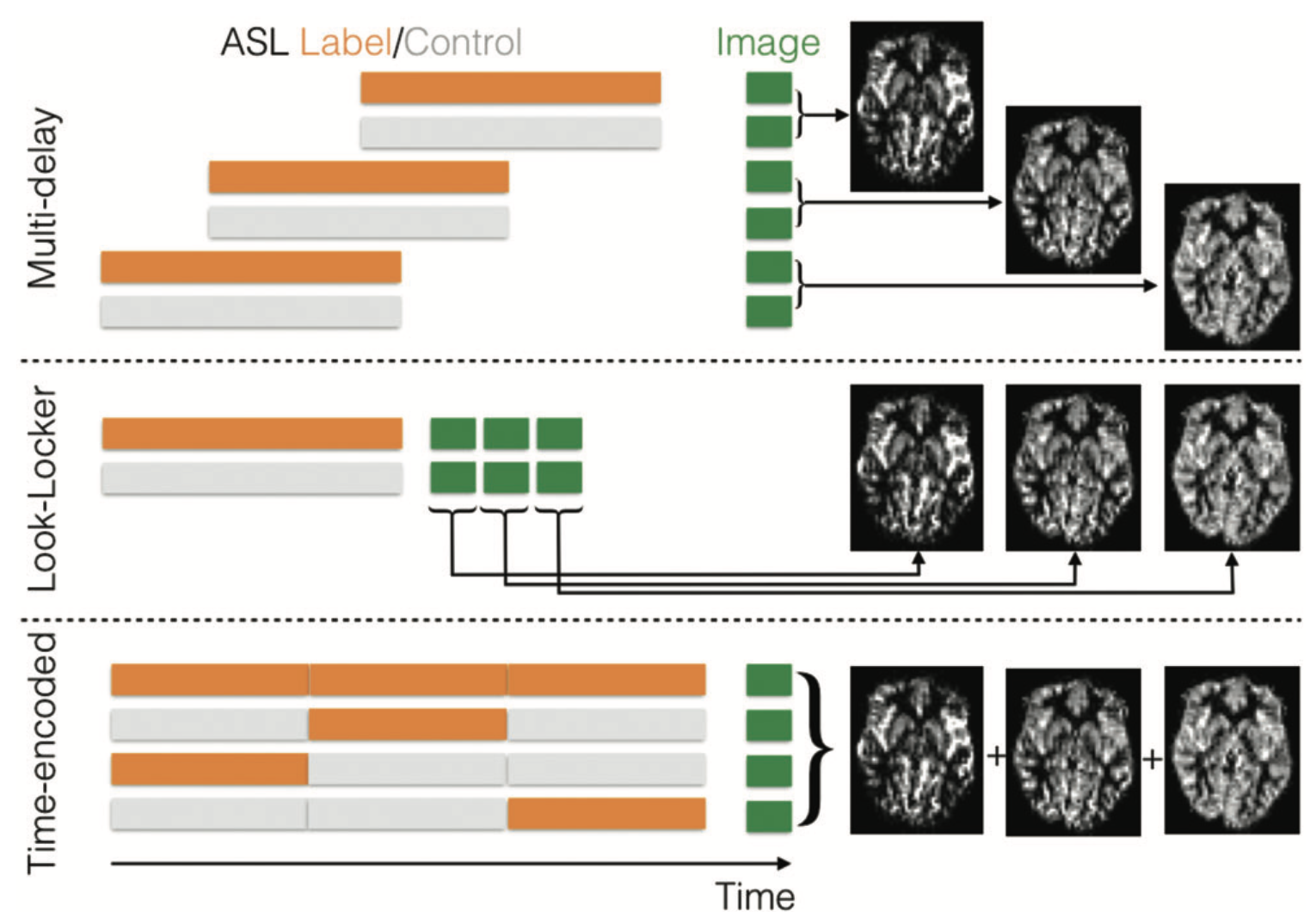
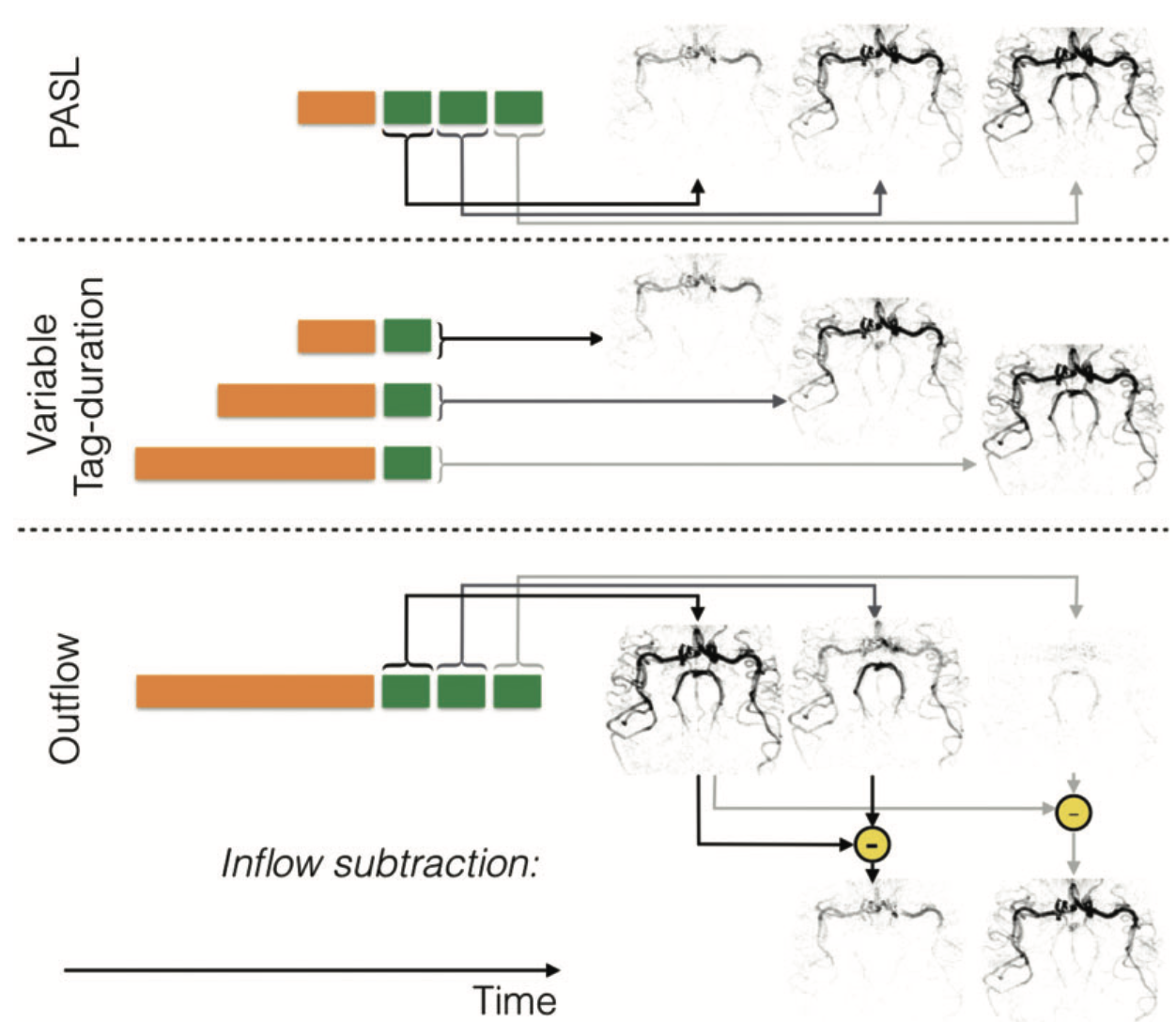
<p>一般ASL会固定post labeling delay，多次label/control/acquisition，再取平均。这要求在delay time中，所有的labeled blood 在acquisition 就已经到达 imaging plane，同时时间不能太长防止完全relaxation。但是ATT事先并不能知道。</p>

<p>如果想要确定ATT，acquire image at various delays</p>

<div class="row mt-3"><div class="col-sm mt-3 mt-md-0"><img class="img-fluid rounded z-depth-1" src="/assets/img/Arterial%20spin%20labeling%20for%20the%20measurement%20of%20cere%20154e90dbf9c8463e9136e93a1758a914/Untitled%201.png" data-zoomable="" /></div></div>

<h3 id="velocity-selective-labeling">velocity-selective labeling</h3>

<ol>
  <li>velocity above $v_c$ is labeled</li>
  <li>then velocity above $v_c$ is crushed</li>
  <li>target the spin from above $v_c$ to below $v_c$</li>
</ol>

<p><strong>Disadvantage</strong>:</p>

<p>SNR penalty, diffusion &amp; eddy distortion, only those move along gradient direction can be labeled</p>

<p><strong>not practical</strong></p>

<h3 id="vessel-selective-labeling">Vessel-selective labeling</h3>

<p><strong>motivation</strong>:</p>

<ol>
  <li>看似正常的perfusion可能实际上是其他artery 的 collateral flow</li>
  <li>incorrect assignment of an infarct to a particular feeding artery</li>
</ol>

<ul>
  <li>Single artery selective methods
    <ul>
      <li>limited excitation field</li>
      <li>pencil beam 2D RF pulse, rotate the labeling plane</li>
      <li>modified pCASL, gradient blips between RF pulse, reduction in the size of labeling spot</li>
    </ul>

    <p>SNR efficiency is reduced</p>
  </li>
  <li>Vessel-encoded methods
    <ul>
      <li>Hardamard encoding: preserve SNR efficiency</li>
      <li>random encodings: decrease in SNR efficiency</li>
      <li>Fourier based encoding</li>
    </ul>
  </li>
</ul>

<h2 id="kinetic-modeling">Kinetic modeling</h2>

<ul>
  <li>
    <p>AIF</p>
  </li>
  <li>
    <p>Residue function</p>
  </li>
  <li>
    <p>The simple model</p>

    <p>assumes that all label arriving in the voxel remains there</p>

    <p>majority of labeled blood water exchanges rapidly from the blood compartment into tissue</p>

    <p>clearance of label directly through the vasculature or via back-exchange from tissue to blood is negligible</p>
  </li>
  <li>
    <p>The standard model</p>
  </li>
  <li>
    <p>Model inversion</p>
    <ul>
      <li>
        <p>Model based</p>

        <p><strong><em>Variational Bayesian Inference for a Nonlinear Forward Model</em></strong></p>

        <p><strong><em>Combined spatial and non-spatial prior for inference on MRI time-series</em></strong></p>
      </li>
      <li>
        <p>Model free</p>
      </li>
    </ul>
  </li>
</ul>

<h2 id="quantification-and-calibration">Quantification and calibration</h2>

<p>$O^{15}$ PET is the gold standard</p>

<h2 id="partial-volume-effects">Partial volume effects</h2>

<p>ASL的分辨率～3mm，因此在一个voxel中可能同时包含GM和WM，由于两者的perfusion value不同，导致混合后的数值有偏差</p>

<p>Spatial PV: <strong><em>Partial volume correction of multiple inversion time arterial spin labeling MRI data</em></strong></p>

<h2 id="asl-angiography">ASL angiography</h2>

<div class="row mt-3"><div class="col-sm mt-3 mt-md-0"><img class="img-fluid rounded z-depth-1" src="/assets/img/Arterial%20spin%20labeling%20for%20the%20measurement%20of%20cere%20154e90dbf9c8463e9136e93a1758a914/Untitled%202.png" data-zoomable="" /></div></div>

<h3 id="labeling-approaches">Labeling approaches</h3>

<h3 id="readouts">Readouts</h3>

<h3 id="modeling-and-quantification">Modeling and quantification</h3>

<h2 id="application-of-asl">Application of ASL</h2>]]></content><author><name>Qijia Shen</name></author><category term="ASL" /><category term="MRI" /><category term="Paper" /><category term="Review" /><summary type="html"><![CDATA[ASL 作用：quantitative measurement of cerebral perfusion and cerebral angiography ASL 主要类型：PASL (pulsed ASL), CASL (continuous ASL), vsASL (velocity-selective ASL), pCASL (pseudo-continuous ASL)]]></summary></entry><entry><title type="html">Combined angiography and perfusion using radial imaging and arterial spin labeling</title><link href="https://michaelsqj.github.io/blog/2021/Combined-angiography-and-perfusion-using-radial-im-0504fecf68484a3b90cf56229fa6f4be/" rel="alternate" type="text/html" title="Combined angiography and perfusion using radial imaging and arterial spin labeling" /><published>2021-09-25T00:00:00+08:00</published><updated>2021-09-25T00:00:00+08:00</updated><id>https://michaelsqj.github.io/blog/2021/Combined%20angiography%20and%20perfusion%20using%20radial%20im%200504fecf68484a3b90cf56229fa6f4be</id><content type="html" xml:base="https://michaelsqj.github.io/blog/2021/Combined-angiography-and-perfusion-using-radial-im-0504fecf68484a3b90cf56229fa6f4be/"><![CDATA[]]></content><author><name>Qijia Shen</name></author><category term="ASL" /><category term="MRI" /><category term="Paper" /><summary type="html"><![CDATA[]]></summary></entry><entry><title type="html">Compressed Sensing MRI</title><link href="https://michaelsqj.github.io/blog/2021/Compressed-Sensing-MRI-2e585f9bd8a64b38beec1bf5b8d8267d/" rel="alternate" type="text/html" title="Compressed Sensing MRI" /><published>2021-09-25T00:00:00+08:00</published><updated>2021-09-25T00:00:00+08:00</updated><id>https://michaelsqj.github.io/blog/2021/Compressed%20Sensing%20MRI%202e585f9bd8a64b38beec1bf5b8d8267d</id><content type="html" xml:base="https://michaelsqj.github.io/blog/2021/Compressed-Sensing-MRI-2e585f9bd8a64b38beec1bf5b8d8267d/"><![CDATA[<p>3 requirements for CS application</p>

<ul>
  <li>Transform Sparsity</li>
  <li>Incoherence of undersampling artifacts</li>
  <li>Nonlinear reconstruction</li>
</ul>

<p>Sampling must be incoherent, (random ideally). 实际上，sampling trajectory 必须满足hardware和physiological constraints。<strong>Non-Cartesian sampling is highly sensitive to system imperfections.</strong></p>

<p>uniform random sampling 不是在k-space上均匀采样，而应该考虑能量分布的uniform。所以应该是中心位置密一些，外围采样稀疏一些。</p>

<h2 id="measuring-incoherence">Measuring Incoherence</h2>

<h2 id="applications-of-compressed-sensing-to-mri">Applications of compressed sensing to MRI</h2>

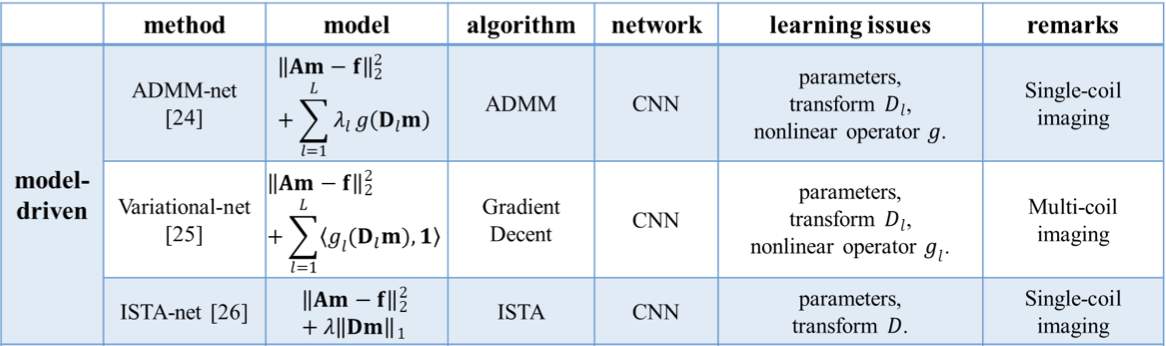
<h3 id="rapid-3d-angiography">Rapid 3D angiography</h3>]]></content><author><name>Qijia Shen</name></author><category term="Compress_Sensing" /><category term="MRI" /><category term="Paper" /><category term="Review" /><summary type="html"><![CDATA[3 requirements for CS application]]></summary></entry><entry><title type="html">Deep MRI Reconstruction Unrolled Optimization Algorithms Meet Neural Networks</title><link href="https://michaelsqj.github.io/blog/2021/Deep-MRI-Reconstruction-Unrolled-Optimization-Algo-4f9f234d9e42436cb2c37efc284614b8/" rel="alternate" type="text/html" title="Deep MRI Reconstruction Unrolled Optimization Algorithms Meet Neural Networks" /><published>2021-09-25T00:00:00+08:00</published><updated>2021-09-25T00:00:00+08:00</updated><id>https://michaelsqj.github.io/blog/2021/Deep%20MRI%20Reconstruction%20Unrolled%20Optimization%20Algo%204f9f234d9e42436cb2c37efc284614b8</id><content type="html" xml:base="https://michaelsqj.github.io/blog/2021/Deep-MRI-Reconstruction-Unrolled-Optimization-Algo-4f9f234d9e42436cb2c37efc284614b8/"><![CDATA[<p>Three categories: <strong>data driven</strong> [6-16], <strong>model driven</strong> [23-26], <strong>integrated</strong> [17-22]</p>

<h2 id="basics-of-deep-learning-and-mri-reconstruction">Basics of deep learning and MRI reconstruction</h2>

<p>Compressed sensing: sparsity prior is enforced by <strong>sparsifying transform</strong> or <strong>data-driven dictionaries. (Cons: high computational complexity)</strong></p>

<p>deep learning: goes beyond CS by extending key ingredients of CS, <strong>adaptive sparsity</strong> and <strong>non-linearity of the representation</strong></p>

<h2 id="model-driven-deep-learning-for-fast-mr">Model-driven deep learning for fast MR</h2>

<p>establish the model → choose optimization algorithm → unroll the algorithm to deep network</p>

<div class="row mt-3"><div class="col-sm mt-3 mt-md-0"><img class="img-fluid rounded z-depth-1" src="/assets/img/Deep%20MRI%20Reconstruction%20Unrolled%20Optimization%20Algo%204f9f234d9e42436cb2c37efc284614b8/Untitled.png" data-zoomable="" /></div></div>

<h3 id="1-admm-net-alternating-direction-method-of-multipliers-single-coil">1) ADMM-net (alternating direction method of multipliers) (single coil)</h3>

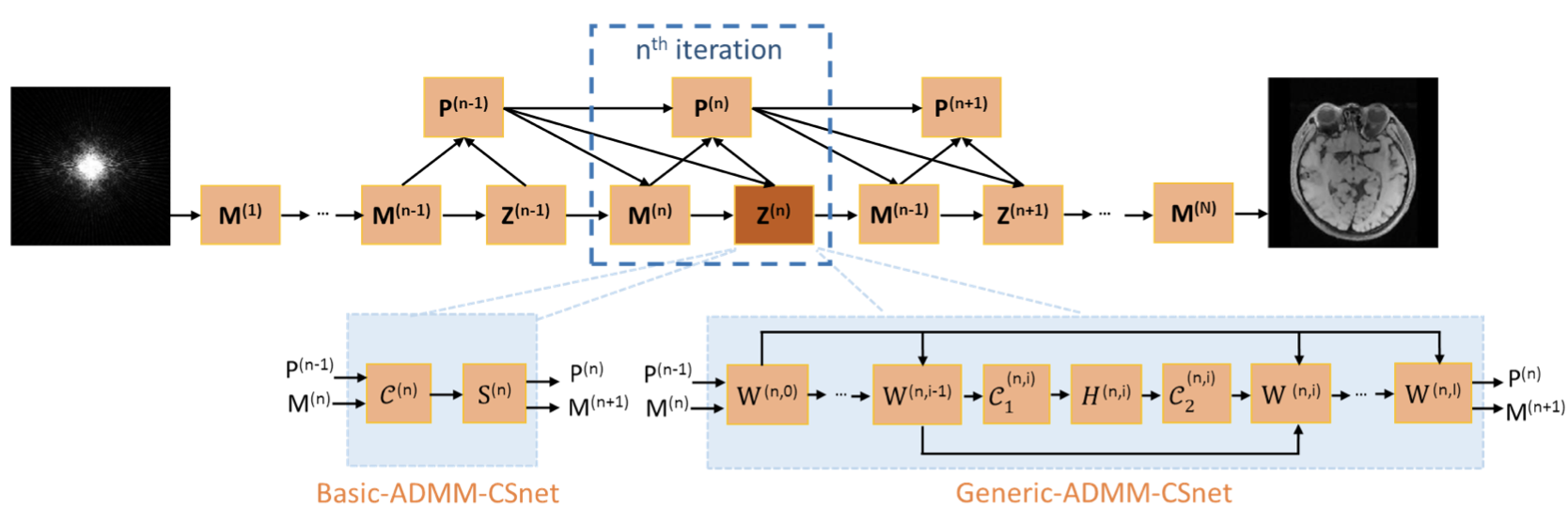
<p><strong>basic-ADMM-CSNet</strong>: learns the regularization parameters in the ADMM algorithm</p>

<p>(<em>Deep ADMM-Net for Compressive Sensing MRI</em>) (read code)</p>

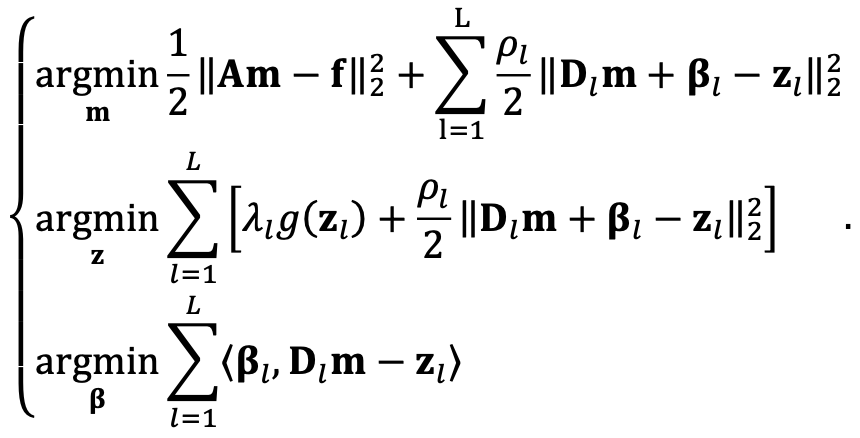
\[min\quad \frac{1}{2}||Am-f||_2^2+\sum _l\lambda_lg(\mathbf{z_l})+\sum_l&lt;\mathbf{\beta_l,D_lm-z_l}&gt;+\sum_l\frac{\rho_l}{2}||\mathbf{z_l-D_lm}||_2^2\]

<p>augmented Lagrangian function: 最后一项是penalty</p>

<p>&lt; = &gt;</p>

<div class="row mt-3"><div class="col-sm mt-3 mt-md-0"><img class="img-fluid rounded z-depth-1" src="/assets/img/Deep%20MRI%20Reconstruction%20Unrolled%20Optimization%20Algo%204f9f234d9e42436cb2c37efc284614b8/Untitled%201.png" data-zoomable="" /></div></div>

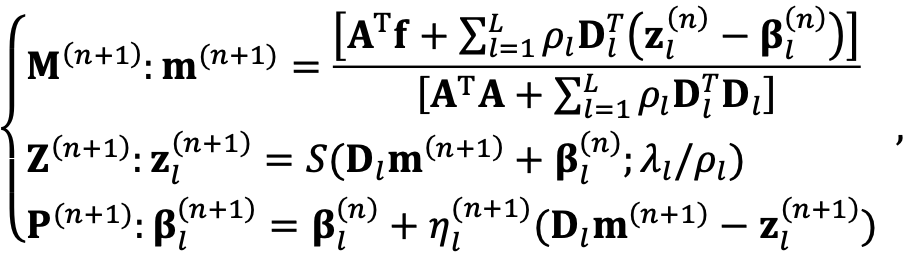
<p>求得</p>

<div class="row mt-3"><div class="col-sm mt-3 mt-md-0"><img class="img-fluid rounded z-depth-1" src="/assets/img/Deep%20MRI%20Reconstruction%20Unrolled%20Optimization%20Algo%204f9f234d9e42436cb2c37efc284614b8/Untitled%202.png" data-zoomable="" /></div></div>

<p><strong>Generic-ADMM-CSNet</strong>: learns the image transformations and nonlinear operators used for the regularization function</p>

<p>(<em>ADMM-CSNet: A Deep Learning Approach for Image Compressive Sensing</em>)</p>

<p><strong>区别在于</strong>$\mathbf{z={z_1,z_2,…,z_l}}$是在spatial domain，因此$\mathbf{D_lz}$ is sparse</p>

<div class="row mt-3"><div class="col-sm mt-3 mt-md-0"><img class="img-fluid rounded z-depth-1" src="/assets/img/Deep%20MRI%20Reconstruction%20Unrolled%20Optimization%20Algo%204f9f234d9e42436cb2c37efc284614b8/Untitled%203.png" data-zoomable="" /></div></div>

<h3 id="2-variational-net-multi-coil">2) Variational-net (multi-coil)</h3>

<p>(<em>Learning a variational network for reconstruction of accelerated MRI data</em>) (read code)</p>

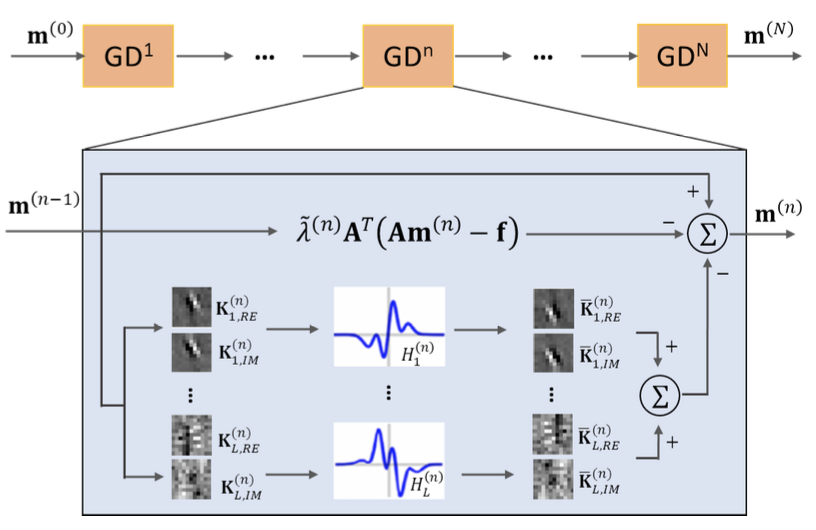
<p>$G(\mathbf{m})=\sum_l&lt;g_l(\mathbf{D_lm}),1&gt;$</p>

<p>其中$D_l$表示convolution with kernel $\mathbf{K_l}$ (<strong>learnable params</strong>)</p>

<p>$H_l^{(n)}$是activation function(<strong>learnable params</strong>)</p>

<p>$\lambda^{(n)}$ (<strong>learnable params</strong>)</p>

<p>$A$由sub-Nyquist Fourier encoding和sensitivity encoding 构成</p>

<div class="row mt-3"><div class="col-sm mt-3 mt-md-0"><img class="img-fluid rounded z-depth-1" src="/assets/img/Deep%20MRI%20Reconstruction%20Unrolled%20Optimization%20Algo%204f9f234d9e42436cb2c37efc284614b8/Untitled%204.png" data-zoomable="" /></div></div>

<h3 id="3-ista-net-iterative-shrinkage-thresholding-algorithm">3) ISTA-net (iterative shrinkage-thresholding algorithm)</h3>

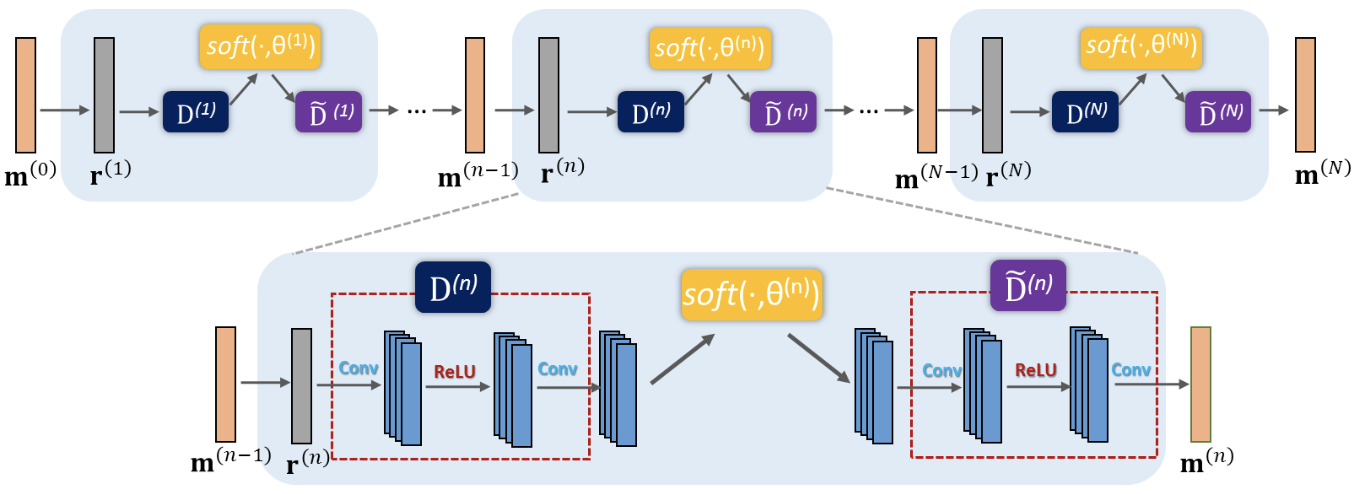
<p>(<em>ISTA-Net: Interpretable Optimization-Inspired Deep Network for Image Compressive Sensing</em>)</p>

<div class="row mt-3"><div class="col-sm mt-3 mt-md-0"><img class="img-fluid rounded z-depth-1" src="/assets/img/Deep%20MRI%20Reconstruction%20Unrolled%20Optimization%20Algo%204f9f234d9e42436cb2c37efc284614b8/Untitled%205.png" data-zoomable="" /></div></div>

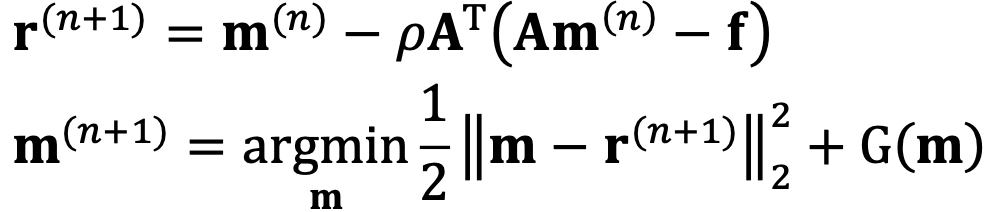
<p>传统的ISTA算法</p>

<p>其中$G(\mathbf{m})=\lambda||\mathbf{Dm}||_1$，$\rho$是step size</p>

<p>传统ISTA算法缺点是当$\mathbf{D}$是non-orthogonal, non-linear的时候，很难算出$\mathbf{m}^{(n+1)}$</p>

<div class="row mt-3"><div class="col-sm mt-3 mt-md-0"><img class="img-fluid rounded z-depth-1" src="/assets/img/Deep%20MRI%20Reconstruction%20Unrolled%20Optimization%20Algo%204f9f234d9e42436cb2c37efc284614b8/Untitled%206.png" data-zoomable="" /></div></div>

<p>ISTA-net</p>

<p>ISTA net 将ISTA的优化目标改成了如下形式</p>

<div class="row mt-3"><div class="col-sm mt-3 mt-md-0"><img class="img-fluid rounded z-depth-1" src="/assets/img/Deep%20MRI%20Reconstruction%20Unrolled%20Optimization%20Algo%204f9f234d9e42436cb2c37efc284614b8/Untitled%207.png" data-zoomable="" /></div></div>

<p>进而获得解如下？</p>

<div class="row mt-3"><div class="col-sm mt-3 mt-md-0"><img class="img-fluid rounded z-depth-1" src="/assets/img/Deep%20MRI%20Reconstruction%20Unrolled%20Optimization%20Algo%204f9f234d9e42436cb2c37efc284614b8/Untitled%208.png" data-zoomable="" /></div></div>

<h2 id="data-driven-deep-learning-for-fast-mr">Data-driven deep learning for fast MR</h2>

<p>aliased image → clean image (<em>Accelerating Magnetic Resonance Imaging via Deep Learning</em>)</p>

<h3 id="1-basic-data-driven-network-for-mr-reconstruction">1) Basic data-driven network for MR reconstruction</h3>

<p>AUTOMAP: k-space data → 1 layer fully-connected network → reconstructed image</p>

<p>RAKI: 3 layer CNN for k-space interpolation (parallel imaging)</p>

<p>GAN: correct aliasing artifacts from undersampled data</p>

<p>(<em>Compressed Sensing MRI Reconstruction Using a Generative Adversarial Network With a Cyclic Loss</em>)</p>

<p>(<em>Deep Generative Adversarial Neural Networks for Compressive Sensing MRI</em>)</p>

<p>QSMnet: 3D U-Net → QSM from single orientation data</p>

<p>DRONE: 4-layer MLP → tissue properties and predict T1 and T2 from 2D MRF data.</p>

<h3 id="2-domain-knowledge-from-mri">2) Domain knowledge from MRI</h3>

<ul>
  <li>Fourier transform
    <ul>
      <li></li>
    </ul>
  </li>
  <li>
    <p>Regularization term</p>

    <p>2 options to integrate <strong>network</strong> and <strong>CS</strong></p>

    <p>read (<em>Accelerating Magnetic Resonance Imaging via Deep Learning</em>)</p>

    <ul>
      <li>use the image reconstructed from the trained network as <strong>initialization</strong> for CS</li>
      <li>use the image generated by network as reference image in additional regularization</li>
    </ul>
  </li>
  <li>
    <p>Data consistency</p>

    <p>consistency between data in image space and k-space</p>

    <ul>
      <li>KIKI-net</li>
    </ul>

    <div class="row mt-3"><div class="col-sm mt-3 mt-md-0"><img class="img-fluid rounded z-depth-1" src="/assets/img/Deep%20MRI%20Reconstruction%20Unrolled%20Optimization%20Algo%204f9f234d9e42436cb2c37efc284614b8/Untitled%209.png" data-zoomable="" /></div></div>
  </li>
  <li>spatio-temporal correlations
    <ul>
      <li>residual U-net</li>
      <li>convolutional RNN</li>
    </ul>
  </li>
  <li>Quantitative parameters</li>
</ul>

<h2 id="integrated-deep-learning-for-fast-mr">Integrated deep learning for fast MR</h2>

<p>特点</p>

<ul>
  <li>It is an unrolling version of optimization algorithm</li>
  <li>at least one sub-problem is solved using data-driven “black box”</li>
</ul>

<h3 id="1-connection-between-two-approaches">1) Connection between two approaches</h3>

<h3 id="2-integrated-approaches-for-mr-reconstruction">2) Integrated approaches for MR reconstruction</h3>

<ul>
  <li>MoDL</li>
</ul>

<p><em>MoDL: Model-Based Deep Learning Architecture for Inverse Problems</em></p>

\[\mathbf{m}^{(n+1)}=argmin||\mathbf{Am-f}||_2^2+\lambda||\mathbf{m-z^{(n)}}||^2_2\]

\[\mathbf{z}^{(n+1)}=C(\mathbf{m}^{(n+1)})\]

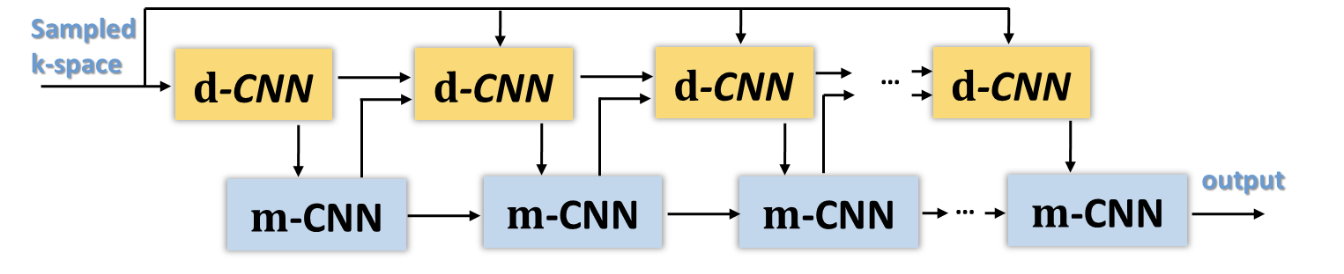
<div class="row mt-3"><div class="col-sm mt-3 mt-md-0"><img class="img-fluid rounded z-depth-1" src="/assets/img/Deep%20MRI%20Reconstruction%20Unrolled%20Optimization%20Algo%204f9f234d9e42436cb2c37efc284614b8/Untitled%2010.png" data-zoomable="" /></div></div>

<p><strong>regularization term</strong>: 降噪后的和降噪前的图像的差别是稀疏的</p>

<ul>
  <li>DCCNN</li>
</ul>

<p><em>A Deep Cascade of Convolutional Neural Networks for Dynamic MR Image Reconstruction</em></p>

<ul>
  <li>PD-net</li>
</ul>

<p><em>Learning Primal Dual Network for Fast MR Imaging</em></p>

<p>unrolling version of the primal dual algorithm</p>

\[min\quad F(\mathbf{Am})+G(\mathbf{m)}\]

\[\left\{\begin{aligned}
  d_{n+1}&amp;=C_1(d_n,Am_n,f)\\
  m_{n+1}&amp;=C_2(m_n,A^{*}d_{n+1})\\
\end{aligned}\right.\]

<div class="row mt-3"><div class="col-sm mt-3 mt-md-0"><img class="img-fluid rounded z-depth-1" src="/assets/img/Deep%20MRI%20Reconstruction%20Unrolled%20Optimization%20Algo%204f9f234d9e42436cb2c37efc284614b8/Untitled%2011.png" data-zoomable="" /></div></div>

<h2 id="some-signal-processing-issues">Some signal processing issues</h2>

<h3 id="1-theoretical-analysis">1) Theoretical analysis</h3>

<p>framelet</p>

<h3 id="2-transfer-learning">2) Transfer learning</h3>

<ul>
  <li>
    <p>contrast, SNR, image content difference between training &amp; testing data</p>

    <p>→ noise + slightly blurred images with <strong>residual artifacts</strong></p>
  </li>
  <li>network trained on regular undersampled data can be generalized to randomly undersampled data</li>
  <li>
    <p>AUTOMAP: train on natural images → apply to MRI images</p>

    <p><em>Image reconstruction by domain-transform manifold learning</em></p>
  </li>
</ul>

<h3 id="3-relationship-with-other-learning-based-approaches">3) Relationship with other learning-based approaches</h3>

<ul>
  <li>
    <p>compressed sensing with dictionary learning</p>

    <p><strong>linear transform learned using simulated data from theoretical model/ low-res image</strong></p>

    <p><em>MR image reconstruction from highly undersampled k-space data by dictionary learning</em></p>

    <p><em>Adaptive Dictionary Learning in Sparse Gradient Domain for Image Recovery</em></p>
  </li>
  <li>
    <p>compressed sensing with manifold learning</p>

    <p><strong>nonlinear prior of low-dim manifold is learned from training data</strong></p>
  </li>
</ul>

<h3 id="4-other-issues-in-deep-learning-approaches">4) Other issues in deep learning approaches</h3>

<p>separate the <strong>real</strong> &amp; <strong>imaginary</strong>  / <strong>magnitude</strong> &amp; <strong>phase</strong> parts into two channels</p>

<p>To handle <strong>multi-coil</strong> data:</p>

<ul>
  <li>convey the pre-calculated coil sensitivity into the network</li>
  <li>reconstruct the image from the multi-channel data through network</li>
  <li>learns the k-space interpolation from ACS data</li>
</ul>

<p>Non-cartesian reconstruction</p>

<ul>
  <li>AUTOMAP: reconstruct directly from non-Cartesian samples</li>
  <li>domain adaptation from CT projection</li>
</ul>

<p><em>Deep learning with domain adaptation for accelerated projection-reconstruction MR</em></p>

<h3 id="5-future-directions">5) Future Directions</h3>

<p>Deep learning to integrate reconstruction &amp; diagnostic</p>]]></content><author><name>Qijia Shen</name></author><category term="MRI" /><category term="Machine_Learning" /><category term="Paper" /><category term="Review" /><summary type="html"><![CDATA[Three categories: data driven [6-16], model driven [23-26], integrated [17-22]]]></summary></entry><entry><title type="html">Deep-Learning Methods for Parallel Magnetic Resonance Image Reconstruction</title><link href="https://michaelsqj.github.io/blog/2021/Deep-Learning-Methods-for-Parallel-Magnetic-Resona-a0173c99f1614ddb97103474c53c07ff/" rel="alternate" type="text/html" title="Deep-Learning Methods for Parallel Magnetic Resonance Image Reconstruction" /><published>2021-09-25T00:00:00+08:00</published><updated>2021-09-25T00:00:00+08:00</updated><id>https://michaelsqj.github.io/blog/2021/Deep-Learning%20Methods%20for%20Parallel%20Magnetic%20Resona%20a0173c99f1614ddb97103474c53c07ff</id><content type="html" xml:base="https://michaelsqj.github.io/blog/2021/Deep-Learning-Methods-for-Parallel-Magnetic-Resona-a0173c99f1614ddb97103474c53c07ff/"><![CDATA[<p><strong>image domain</strong>: SENSE</p>

<p><strong>k-space</strong>: SMASH (simultaneous acquisition of spatial harmonics), GRAPPA (generalized auto- calibrating partial parallel acquisition)</p>

<h2 id="classical-parallel-imaging-in-the-image-space"><strong>Classical parallel imaging in the image space</strong></h2>

<p>noise amplification: <strong>g-factor</strong></p>

<p><strong>iterative methods</strong> to reduce computing &amp; memory requirements</p>

<p>(gradient descent, Landweber iterations, conjugate gradient)</p>

<p>acceleration factor $\ll$ coil number</p>

\[argmin||Eu-f||_2^2\]

<h3 id="nonlinear-regularization--compressed-sensing">Nonlinear regularization &amp; Compressed sensing</h3>

<ol>
  <li>
    <p>compressed sensing (wavelet transform ) +  pseudorandom sampling</p>
  </li>
  <li>
    <p>TV, TGV regularization(Fourier domain ) + radial/ spiral sampling</p>

    <p>primal-dual method，TGV  (<strong><em>Second Order Total Generalized Variation (TGV) for MRI</em></strong>)</p>
  </li>
  <li>
    <p>low rank based regularization</p>
  </li>
</ol>

<p><strong>Image Quality assessment</strong>:  $\checkmark$ NRMSE, SSIM, PSNR 与gold standard 对比的方法</p>

<div class="language-plaintext highlighter-rouge"><div class="highlight"><pre class="highlight"><code>                                          $$$\times$  SNR based metrics
</code></pre></div></div>

<h2 id="classical-parallel-imaging-in-the-k-space">Classical parallel imaging in the k-space</h2>

<h3 id="linear-k-space-interpolation-in-grappa">Linear k-space interpolation in GRAPPA</h3>

<div class="row mt-3"><div class="col-sm mt-3 mt-md-0"><img class="img-fluid rounded z-depth-1" src="/assets/img/Deep-Learning%20Methods%20for%20Parallel%20Magnetic%20Resona%20a0173c99f1614ddb97103474c53c07ff/Untitled.png" data-zoomable="" /></div></div>

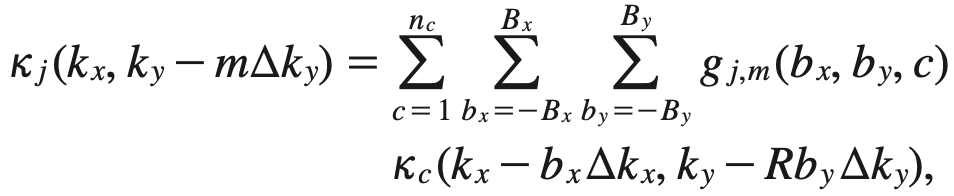
<p>第 j 个线圈的没采集的 k-space 数据 可以由 附近位置，其他所有coil采集的k-space data linear combination 获得</p>

<p>$g_{j,m}()$是权重系数，可以通过采集reference scan或者ACS获得。</p>

<p><strong>原理？why the convolution kernel is shift-invariant</strong></p>

<p><strong>Advantage</strong>:  Lower g-factor, smooth g-factor map than SENSE</p>

<p>disadvantage: noise amplification</p>

<h3 id="advances-in-k-space-interpolation-methods">Advances in k-space interpolation methods</h3>

<p><strong>To</strong> <strong>reduce noise</strong></p>

<p>iterative SPIRiT: enforcing self-consistency among the k-space data in multiple receiver coils by exploiting the correlations between neighbor- ing k-space points</p>

<p>(NL)-GRAPPA: nonlinear k-space interpolation for estimating missing k-space points for uni- formly undersampled parallel imaging acquisitions</p>

<h3 id="low-rank-matrix-completion-for-k-space-reconstruction">Low rank matrix completion for k-space reconstruction</h3>

<h2 id="machine-learning-methods-for-parallel-imaging-in-the-image-space"><strong>Machine-learning methods for parallel imaging in the image space</strong></h2>

<p>iterative algorithm → structure of neural network;   every layer → iteration step?</p>

<h2 id="machine-learning-methods-for-parallel-imaging-in-the-k-space"><strong>Machine-learning methods for parallel imaging in the k-space</strong></h2>

<ol>
  <li><strong>scan-specific</strong> ACS lines to train neural networks (like GRAPPA, NL-GRAPPA)
    <ol>
      <li>
        <p>robust artificial neural network for k-space interpolation (RAKI)</p>

        <p><strong><em>Scan‐specific robust artificial‐neural‐networks for k‐space interpolation (RAKI) reconstruction: Database‐free deep learning for fast imaging</em></strong></p>

        <p>use CNNs to train, using ACS data with MSE loss</p>

        <p>reduce noise using coil geometry not image structure</p>

        <p><strong>disadvantage</strong>: computational burden, training for each scan</p>

        <p><strong>residual RAKI</strong>: residual CNN to reduce noise &amp; remove artifacts</p>

        <p><strong><em>Accelerated MRI using residual RAKI: Scan-specific learning of reconstruction artifacts</em></strong></p>

        <p><strong><em>Accelerated simultaneous multi-slice MRI using subject-specific convolutional neural networks</em></strong></p>
      </li>
    </ol>
  </li>
  <li>
    <p>using training databases to train</p>

    <p><strong>Deep SPIRiT:</strong></p>

    <p><strong><em>DeepSPIRiT: Generalized parallel imaging using deep convolutional neural networks</em></strong></p>

    <p><strong>normalize</strong> training data using <strong>Coil compression</strong></p>

    <p><strong><em>Array compression for MRI with large coil arrays</em></strong></p>

    <p>Hankel-matrix based</p>
  </li>
</ol>]]></content><author><name>Qijia Shen</name></author><category term="ASL" /><category term="MRI" /><category term="Machine_Learning" /><category term="Paper" /><category term="Review" /><summary type="html"><![CDATA[image domain: SENSE]]></summary></entry></feed>